No BELL policy can hold back a withdraw. You do not have to take our word for it: this page shows how to check it from a hook's address, runs that check on every pool, and links a real withdraw we made on mainnet.
Chain 4663 / hook mask 0x2cc0
0xf9692a364e0edf76bba12e54c3eba599f436acc0
10 10 1100 1100 0000
13beforeInitialize, bit 13, set
12afterInitialize, bit 12, clear
11beforeAddLiquidity, bit 11, set
10afterAddLiquidity, bit 10, set
exit9beforeRemoveLiquidity, bit 9, clear, exit bit
exit8afterRemoveLiquidity, bit 8, clear, exit bit
7beforeSwap, bit 7, set
6afterSwap, bit 6, set
5beforeDonate, bit 5, clear
4afterDonate, bit 4, clear
3beforeSwapReturnDelta, bit 3, clear
2afterSwapReturnDelta, bit 2, clear
1afterAddLiquidityReturnDelta, bit 1, clear
exit0afterRemoveLiquidityReturnDelta, bit 0, clear, exit bit
The lowest 14 bits of the address are the hook's permissions. The two bits before them are part of the address and mean nothing. A filled bar means the hook is called at that step. The three marked exit are the ones that would touch a withdraw, and they are empty.
In Uniswap v4 a hook's permissions are not stored anywhere you have to trust. They are the low 14 bits of the hook's own address. The PoolManager calls a hook callback only when its bit is set, so a hook whose remove-liquidity bits are clear is never called while liquidity is removed. That can be read from the address alone, without reading any source code.
BELL hook addresses end in cc0. The digit before it varies, because the two highest of those sixteen bits are not permissions. The fourteen that are read 0x2cc0, which sets five permissions and clears the three that touch removal.
Bit
Permission
In 0x2cc0
13
beforeInitialize
set
12
afterInitialize
clear
11
beforeAddLiquidity
set
10
afterAddLiquidity
set
9
beforeRemoveLiquidityexit
clear
8
afterRemoveLiquidityexit
clear
7
beforeSwap
set
6
afterSwap
set
5
beforeDonate
clear
4
afterDonate
clear
3
beforeSwapReturnDelta
clear
2
afterSwapReturnDelta
clear
1
afterAddLiquidityReturnDelta
clear
0
afterRemoveLiquidityReturnDeltaexit
clear
The three rows marked exit are bits 9, 8 and 0. A hook with any of them set could act when you withdraw. None of BELL's does.
02Every pool, checked
The list below comes from the BELL keeper's /pools, and the arithmetic runs in your browser. If the keeper cannot be reached, it shows the list committed to the repository instead and says so.
Showing the list committed to the repo, generated 2026-11-06. Reading the live list…
6 hooks, 6 PASS, 0 FAIL. 6 carry the BELL mask 0x2cc0.
The deployed bytecode also reports its own permissions through getHookPermissions(). Running the script with --rpc confirms that each hook has code and that what it reports matches what its address says.
03Check any address
Do not trust the table either. Paste a hook address and see its fourteen bits.
Paste any Uniswap v4 hook address. Nothing is sent anywhere.
04A withdraw on the record
One real withdraw from a BELL pool on Robinhood Chain mainnet, through the Uniswap v4 PositionManager. Open the transaction and check it yourself.
DONE
Pre-market withdraw
Exit works in the first session of the day, with session fees and flow caps in force. TSLA / USDG pool, through the Uniswap v4 PositionManager.
The contract tests below run in the Foundry suite. The committed hook list is checked on every push, and the live pool list every six hours. Either check fails the build if any hook has an exit bit set.
testFuzzOwnerCanAlwaysExitAfterAnySequenceOfBellEventsThe fuzzer combines pauses, dead dependencies, stale time, a latched closure and spent budgets in any order. After every step the owner removes all liquidity in kind and BELL's state is unchanged.
The randomised test draws up to 24 events per run and 1,500 runs per pass. It checks the exit after each event on a snapshot it then rolls back. It does not cover swaps, which BELL is allowed to stop, or the Uniswap contracts themselves.
06Run it yourself
Node 24 runs the script directly, with no install for the basic check.
git clone https://github.com/belldex/bell
cd bell

# every pool the keeper lists
node scripts/verify-exit-liveness.ts

# one or more addresses you choose
node scripts/verify-exit-liveness.ts --hook 0x6657dc160e05c0ff6afe2122ca7d8244390decc0

# also check code exists and getHookPermissions() agrees (needs an RPC URL and viem)
node scripts/verify-exit-liveness.ts --rpc https://your-robinhood-chain-rpc
It prints one row per hook with PASS or FAIL and exits with 1 if any hook can touch a withdraw. The source is scripts/verify-exit-liveness.ts and the arithmetic is a few lines in hook-flags.ts.
07What “always” means
It means no BELL policy can hold a withdraw back: no pause, no closed market, no stale feed, no spent budget and no admin action in the BELL contracts stops the owner of a position from removing liquidity.
It does not mean more than that:
Withdrawing goes through the Uniswap v4 PositionManager and PoolManager and needs Robinhood Chain to be running. If either is unavailable, so is every withdraw.
The tokens in a pool are issued by others, and BELL does not control their transfer rules.
You get back the tokens the pool holds for you. That is not a promise about their price, and a position can be worth less than you put in.
Swaps are a different matter. BELL can and does stop swaps in some sessions and states. Only exits are guaranteed.
An independent security audit is not complete. Treat every BELL contract as unaudited. See the terms.
08LP proof: the weekend replay
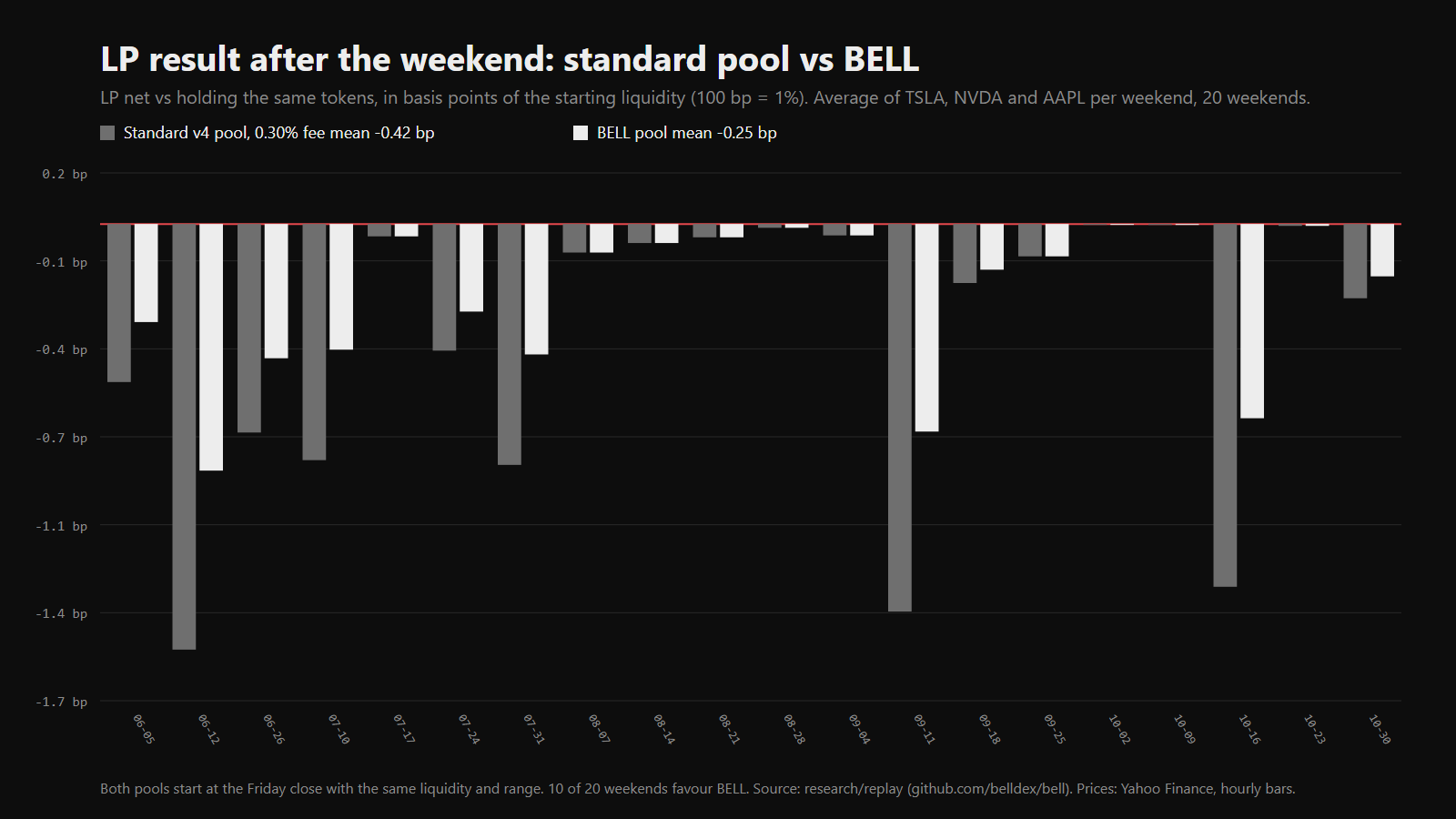
Exit liveness is about getting your tokens out. This section is about what an LP keeps while the market is closed. We replayed 20 real weekends of TSLA, NVDA and AAPL, 2026-06-05 to 2026-10-30, against two pools that start with the same liquidity, the same range and the same price: a standard Uniswap v4 pool with a fixed 0.30% fee, and a BELL pool with the Opening Bell Auction.
This replay is a simulation, not a live weekend result. A live side-by-side test of a standard pool and a BELL pool over a real weekend has not been run. What has run on Robinhood Chain mainnet is listed under the replay.
Over 60 stock-weekends
Standard pool
BELL pool
Average LP result against holding
-0.42 bp
-0.25 bp
Largest loss in one stock-weekend
-3.48 bp
-1.86 bp
Gap of 1% or more (16 rows), average
-1.41 bp
-0.78 bp
Gap under 1% (44 rows), average
-0.06 bp
-0.06 bp
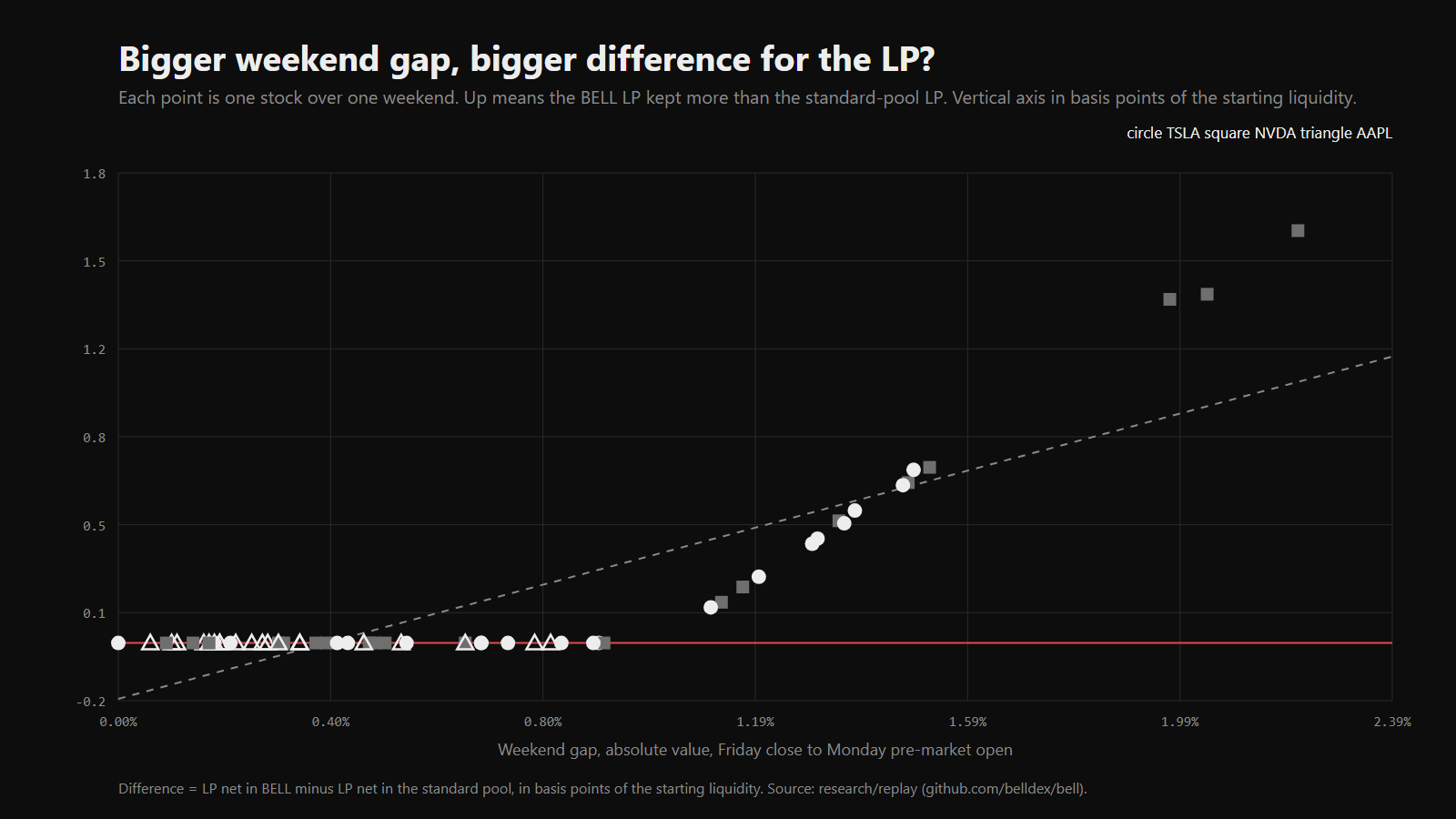
One basis point (bp) is 0.01% of the starting liquidity, which was 100,000 USD in each pool. BELL did better in 16 of 60 rows, the standard pool did better in 0, and 44 were a tie. The ties are the weekends with a gap under about 1%: there both pools end at the same price with the same fees. The difference appears when the gap is large, which is when the closed-session fee and the flow caps act.
In the 16 stock-weekends with a gap of 1% or more, the LP in the standard pool lost -1.41 bp on average and the LP in the BELL pool lost -0.78 bp, which is 45% less. The LP still pays for most of the move in both pools, because the price has to reach its new level either way. The difference comes from fees: arbitrage while the market is closed is charged 1.00% in a BELL pool and 0.30% in the standard pool, and the fee goes to the LP. On 100,000 USD of liquidity, that is a few dollars per stock-weekend.
LP result after the weekend, standard pool against BELL, average of three stocks per weekend.Each point is one stock over one weekend. Up means the BELL LP kept more.
What the simulation assumes, and where it stops:
The arbitrage agent is rational, informed and fast. Real arbitrage is slower and less certain.
Auction participation is simulated: the arbitrage agent plus eight pseudo-random orders per weekend. Real volume may be smaller. The auction matches orders peer to peer and does not move the pool price, so the LP difference above comes from the closed-session fee, the flow caps and the bell fee, not from the auction clearing.
The contracts are the repository's own bytecode run in a Foundry test. It is not a fork of mainnet: tokens, calendar and session data are test doubles.
Prices are hourly bars from Yahoo Finance. The overnight session from 20:00 to 04:00 ET is not in that source.
Results depend on the size of the gap, and the sample is 20 weekends of three stocks.
What has run on Robinhood Chain mainnet so far, each one a transaction you can open:
An LP seeded a USDG/AAPL pool, swapped in it and withdrew all of it within seven minutes on 2 November, during the regular session, before the Opening Bell Auction existed: seed, swap, withdraw.
An LP withdrew all of the liquidity from a TSLA/USDG pool on 6 November, in the pre-market session: withdraw.
A swap above the trade cap on the TSLA/USDG pool reverted with TradeCapExceeded: transaction.
The one real weekend on record is 7 and 8 November. Three funded BELL pools held liquidity through it, and none of them took a swap, so no LP in them paid anything for the weekend. Prices below were read on 9 November at 02:57 UTC; the Friday close is the last post-market bar on 6 November.
Pool
Pool price
Friday close
Difference
Swaps since creation
AAPL/USDG
325.21
342.65
-5.1%
0
NVDA/USDG
207.05
188.70
+9.7%
0
TSLA/USDG
350.34
359.40
-2.5%
0
Read this carefully. The differences come from the price each pool was seeded at, not from the weekend, and nobody has traded to correct them. So these pools show that a BELL pool takes no flow while it sits unpriced, and they do not show that a BELL LP loses less than an LP in a standard pool: there is no standard pool beside them and there was no arbitrage to lose to. What has not run: a live weekend measured side by side with a standard pool, a mainnet withdraw while the market was closed, and an Opening Bell Auction on mainnet with orders in it (the cycle on 9 November closed with none). The amounts are small, so they show that the rules work, not what an LP keeps.
The script, the prices, the result of every row and the charts are in the public repository:research/replay. To rerun it, run forge test --match-contract WeekendReplay -vv from the contracts folder.